

A team member knows why a shipment is late but needs a colleague to explain the problem on a call with a U.S. customer. Another employee can read reports in English but struggles to answer follow-up questions. Both may need training, but they do not necessarily need the same class.
For HR teams planning English training for employees in Latin America, the first decision is what people need to do at work. Start with a small set of communication tasks, assess current ability, then build groups and schedules that employees can realistically maintain. This guide provides a planning worksheet and an illustrative six-person example.
If you are already comparing delivery options, see our live online English training for employees. The steps below will help you prepare the information needed for a useful training proposal.
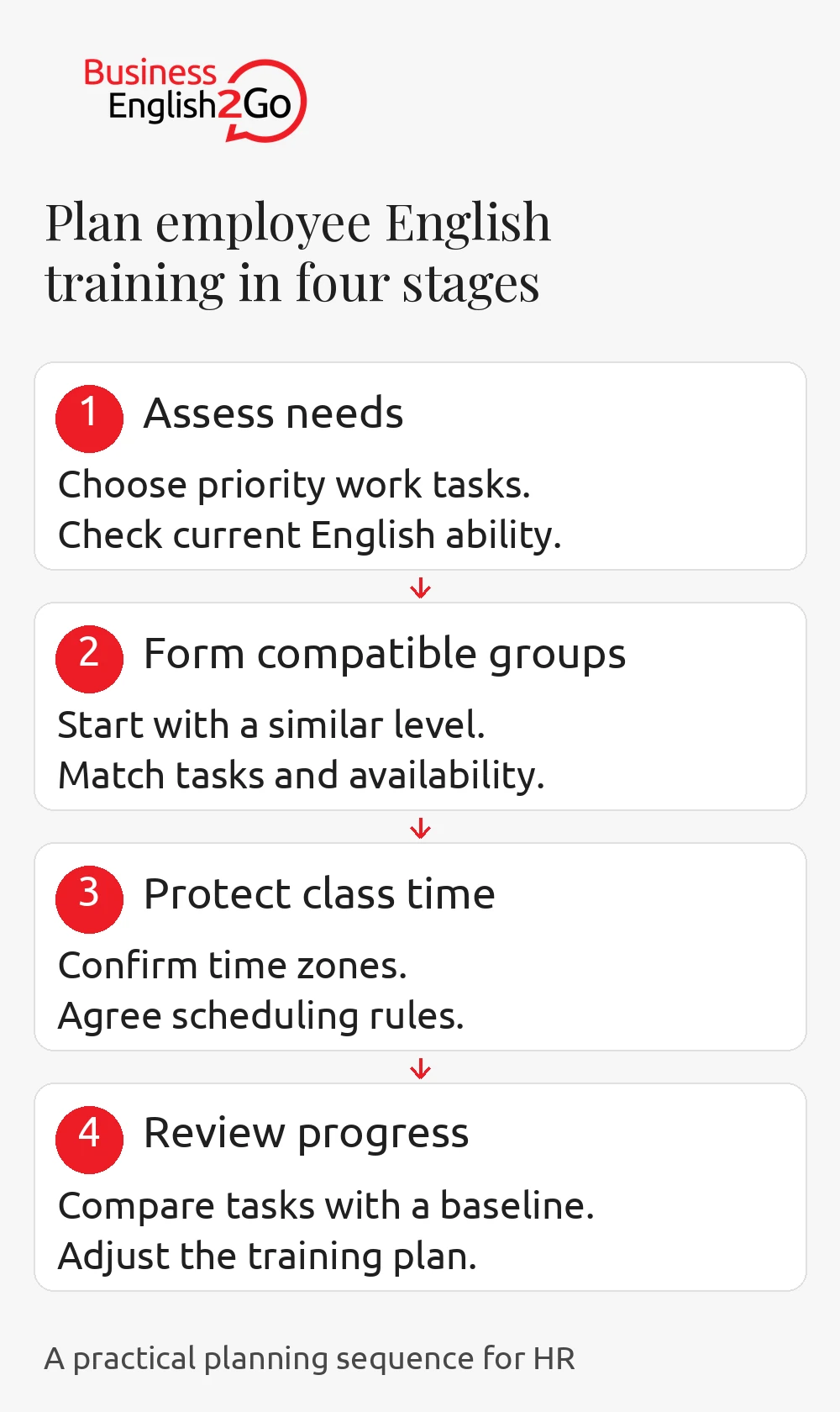
Read the four-stage planning infographic
- Assess needs: choose priority workplace tasks and check current English ability.
- Form compatible groups: start with a similar level, then match tasks and availability.
- Protect class time: confirm time zones and agree scheduling rules.
- Review progress: compare workplace tasks with a baseline and adjust the training plan.
1. Define the work that needs English
“Improve English” does not tell a teacher what to prioritize or a manager what to look for. Ask department leaders for two or three recurring situations where communication is difficult: explaining an operational delay, asking a supplier to confirm a deadline, presenting a project update, or responding to customer questions.
Turn each situation into an observable outcome. Instead of “better speaking,” write “give a two-minute project update covering progress, a risk and the next action, then answer follow-up questions.” For writing, an outcome might be “send a follow-up email that makes the request, owner and deadline clear.” These are planning goals, not promises of a particular result within a fixed number of lessons.
Ask employees as well as their managers. An employee may manage a prepared presentation comfortably but lose the thread when colleagues interrupt. That distinction changes the practice they need: responding and clarifying, rather than memorizing a longer script.
2. Use a short needs worksheet before requesting proposals
Collect enough information to match the training to the work. You do not need to send confidential client messages or internal reports; anonymized examples are usually a better starting point.
| Planning question | What to record |
|---|---|
| Who needs English? | Number of employees, roles, locations and who is funding the training. |
| What do they need to do? | Two or three recurring tasks, the audience and how often each task occurs. |
| What is difficult now? | Examples such as unclear requests, difficulty following questions or reliance on a colleague. |
| What is their current ability? | Any recent assessment, plus what still needs to be checked through speaking, listening or writing. |
| When can they attend? | Protected time windows, each employee’s time zone, peak work periods and likely conflicts. |
| What will count as progress? | A sample task, baseline evidence and an agreed review date. |
| Who coordinates the program? | The HR contact, participating managers and the person who approves scope and budget. |
Keep the distinction between employee development and procurement clear. A company can fund training for a single employee; headcount alone does not make it an individual, self-funded course. Note who approves the proposal and who needs progress information.
3. Assess ability before forming groups
Job title and availability are not enough to place people together. Two managers may have very different listening and speaking abilities. Equally, employees from different departments may work well together when their levels, schedules and communication tasks are compatible.
Use a placement assessment as a starting point and check the skills that matter for the planned work. A multiple-choice result alone does not show how comfortably someone can explain a delay or handle an unexpected question. Share the intended tasks with the provider so assessment and course planning address the same need.
Group by compatible ability first, then consider work tasks and availability. Do not put a beginner into an advanced discussion group simply to fill a seat. Ask the provider how it will confirm placement and handle a group that proves unsuitable once classes begin.
An illustrative six-person plan
The levels and formats below are hypothetical. They show how HR might organize a discussion with a provider; they are not an assessment of real learners or a final grouping recommendation.
| Employee role | Provisional level | Priority task | Possible format |
|---|---|---|---|
| Warehouse supervisor | A2 | Explain a delivery problem and confirm next steps. | Group A, if assessment confirms compatibility. |
| Logistics coordinator | A2 | Ask for shipment updates and clarify dates. | Group A, if schedules also match. |
| Project coordinator | B1 | Give a project update and answer questions. | Group B. |
| Customer service specialist | B1 | Explain a problem and check the customer’s understanding. | Group B, with relevant scenarios. |
| Purchasing analyst | B1 | Clarify a supplier’s proposal and follow up. | Group B, subject to assessment. |
| Finance manager | B2 | Present a forecast and respond to detailed questions. | Consider private instruction for the distinct task and schedule. |
The finance manager does not need private training simply because of seniority. The reason to consider it here is the combination of level, specialized work and scheduling. Compare that need with the available group options before deciding. For a specific leadership communication need, review our executive language training options.
Planning English training for your team?
Build a practical program around your employees’ roles, English levels, and schedules.
4. Protect class time across locations and time zones
Live online delivery removes travel to a classroom, but it does not remove calendar conflicts. Ask each department to identify realistic recurring windows and agree who can protect them. If employees regularly miss class for the same weekly meeting, change the plan before treating attendance as a motivation problem.
For teams working across Latin America and with U.S. colleagues, record actual time zones rather than “morning” or “U.S. time.” Check how daylight saving changes affect shared windows during the proposed training period. Also identify month-end reporting, seasonal peaks and known travel.
Before committing, clarify class frequency, duration, group size, cancellation notice and what happens when someone misses a session. Do not assume that online classes include unlimited rescheduling or automatic make-up lessons. The agreed arrangements should be clear to HR, managers and participants.
Give employees a practical way to use the learning between classes. For example, a supervisor could prepare one short section of a routine update, with appropriate support. Practice should build participation without putting an employee into a client situation they are not ready to handle.
5. Agree how progress will be reviewed
Separate attendance, language development and performance on a work task. Attendance tells you whether employees had access to instruction. It does not, by itself, show what they can now do in English.
At the beginning, agree on a baseline task that fits the objective. For meeting participation, use a short spoken update followed by questions. For email writing, use a realistic request or follow-up. Keep the task and review criteria comparable when you revisit it.
- Participation: review attendance and recurring scheduling problems.
- Task performance: compare clarity, completeness, understanding of questions and the amount of support needed.
- Language development: ask the teacher which recurring language issues are improving and what practice comes next.
For a project update, a simple review might ask whether the employee explained the situation, identified the risk, stated the next action and responded to a clarification question. That gives HR and the learner something more useful than a general comment such as “more confident.”
Agree the first review date with the provider and managers. A monthly operational check can uncover attendance or relevance problems, but it is not the same as a formal level reassessment. Set assessment timing separately; avoid assuming that a learner should move up a CEFR level every month.
6. Compare proposals against the same brief
Send providers the same headcount, role mix, work tasks, assessment needs and availability. Ask each to explain proposed grouping, relevant practice, teacher feedback, reporting and coordination. A lower headline price is hard to evaluate if the offers include different amounts of instruction or different group sizes.
For example, if the priority is handling follow-up questions, ask how learners will practice spontaneous interaction and receive feedback. A course outline that lists “presentations” without explaining the activities does not answer that question.
Our corporate language training page explains the company training options. You can also review current programs and pricing before discussing the scope your team needs.
Prepare your team’s next step
Start with a brief, not a long list of course features: who needs training, what they need to do in English, their locations and available times, and how the company will review progress. Include who approves the program and your intended start date. It is fine to mark levels as “assessment needed” rather than guess.
Explore English training for your team and use your planning brief to start a conversation about suitable live online classes.